Static prompts, dynamic prompts and documents
Understand the three kinds of prompt, how each one behaves when a block changes, and how to write and edit each one.
Everything on the Prompts screen is one of three kinds: a dynamic prompt, a static prompt or a Markdown document. The kind decides where the words come from and how you edit the item. You choose it when you first save, and the app has no button to change it later.
The three kinds
| Kind | What it is | When a block changes | Edited on |
|---|---|---|---|
| Dynamic | A list of blocks, in order. Its text is put together from the blocks each time you use it. | The prompt changes too. | The Build screen |
| Static | Fixed text. | Nothing happens to it. | The Prompts screen |
| Markdown | A Markdown document, such as a Skill, kept exactly as written. | Nothing (it has no blocks). | The Build screen’s Markdown editor |
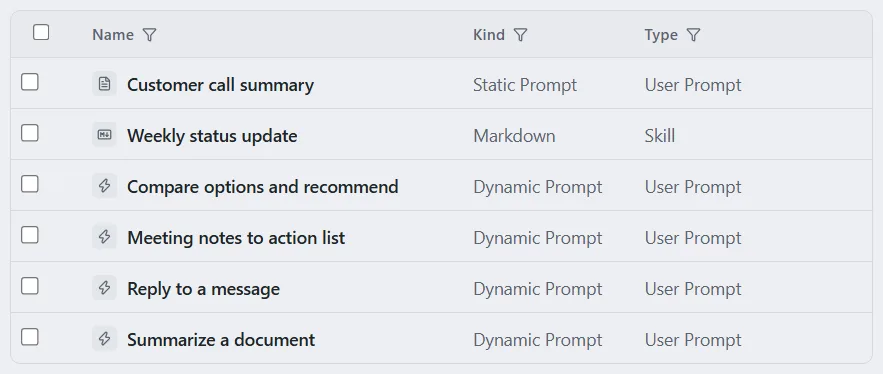
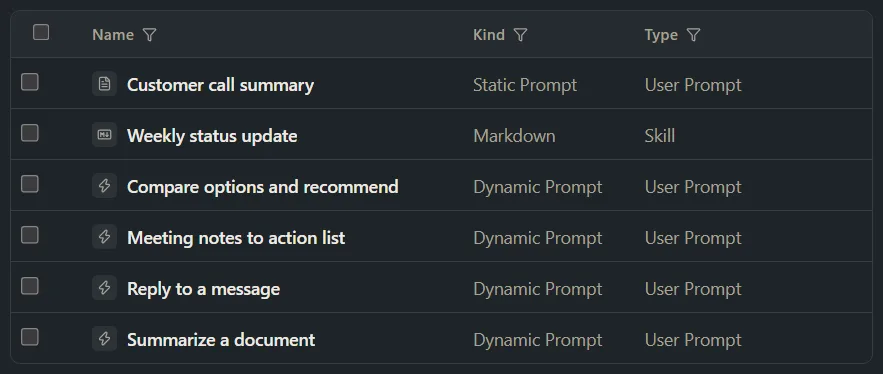
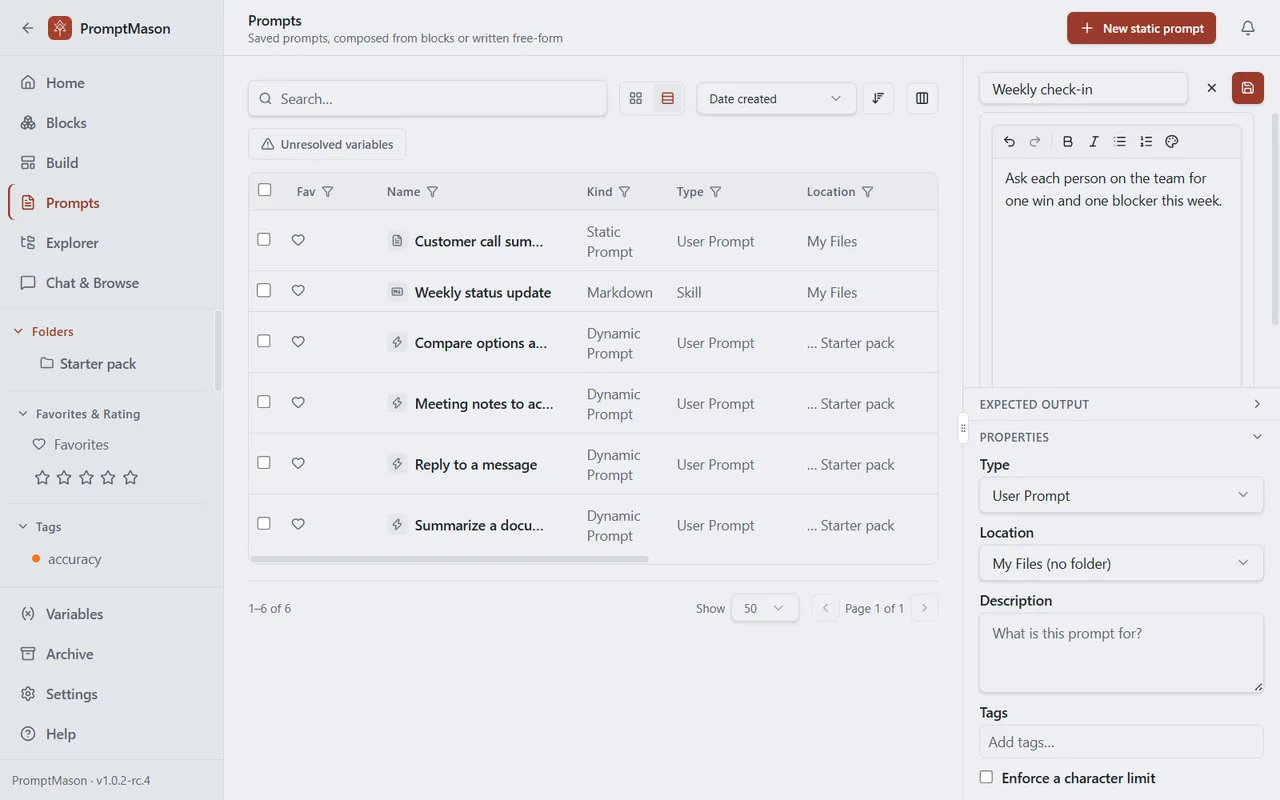
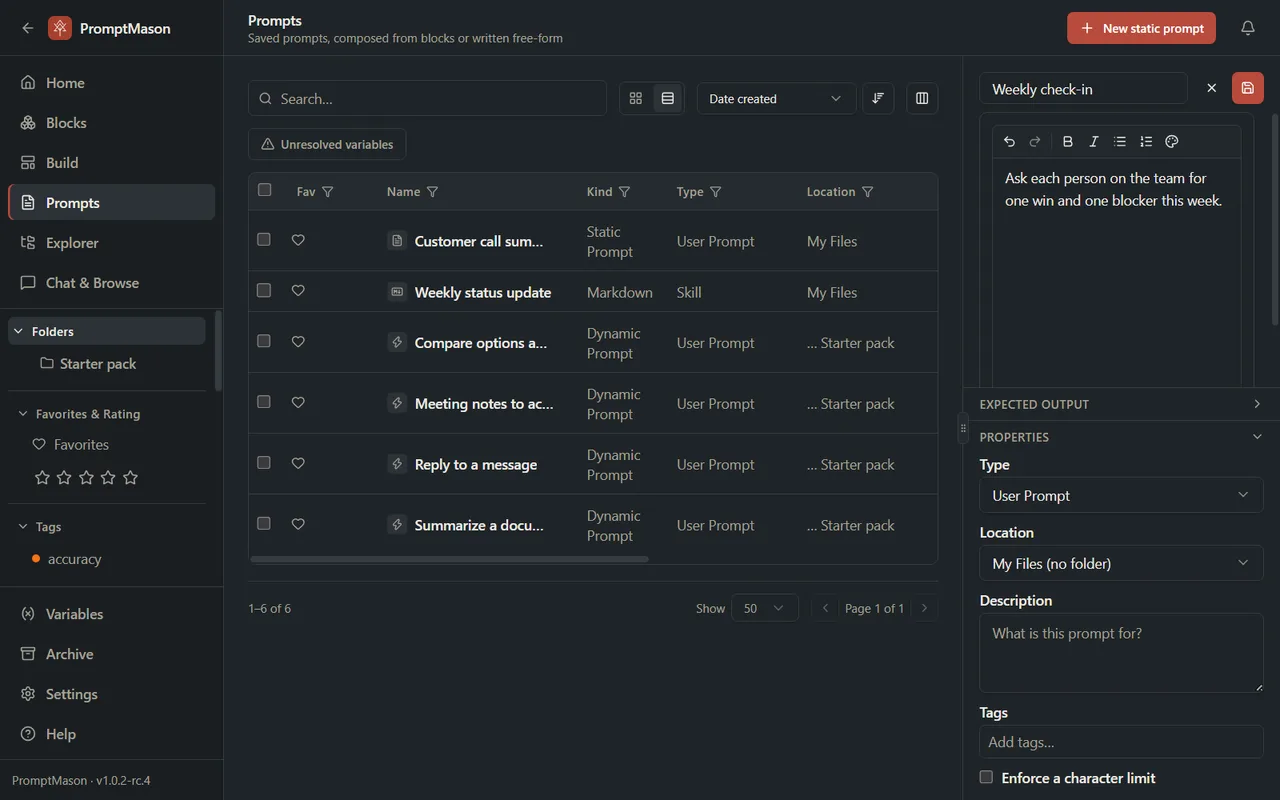
On the Prompts screen, Tile view and the pane on the right show the kind as a badge (Dynamic, Static or Markdown). In List view, the Kind column says Dynamic Prompt, Static Prompt or Markdown.
Dynamic prompts
A dynamic prompt is built from library blocks on the Build screen (Build a prompt). It stores which blocks it uses, in what order, and with which block headers, not the text itself.
Because of that, when you change a block, every dynamic prompt that uses it shows the new text the next time you view or copy it. Fix a typo in your “Role” block once, and all your prompts get the fix.
What happens when a block is removed:
- Archived: the block’s text still goes into the prompt, and the block is marked Archived. To leave it out, open the prompt in Build and take the block out.
- Deleted: the prompt shows
[Block removed: name]in its place, with a warning, until you take it out of the prompt or the block is restored from Recently deleted. See Archive, delete and restore.
Use a dynamic prompt when you want your prompts to stay in step with your blocks. That’s most of the time.
Static prompts
A static prompt is fixed text. You get one in two ways:
- Save as Static on the Build screen. The blocks’ text, with its headers, is saved as one piece of text. From then on the prompt has no link to the blocks: changing or deleting a block doesn’t change it.
- Write it yourself on the Prompts screen (see Write a static prompt).
Variables and hidden notes still work in a static prompt: variables are filled in when you copy it, and hidden notes are left out.
Use a static prompt when you want the words to stay exactly as they are, or for a one-off prompt that isn’t built from blocks.
Markdown documents
A Markdown document is a text file written in Markdown, such as a Skill for an AI tool. PromptMason keeps it exactly as you write it: no blocks, no variables, and nothing removed. You write one on the Build screen’s Markdown tab, which shows when the Markdown editor feature is on. See Markdown documents and Skills.
A document counts as one of the 15 prompts on the Free plan.
Kind and Type
Kind and Type are two different things:
- Kind is Static, Dynamic or Markdown. PromptMason sets it from how you saved the item, and the app doesn’t offer a way to change it.
- Type is a label you choose under Properties, such as User Prompt, System Prompt or Skill. You can change it at any time and add your own types (Block types, prompt types and defaults).
Any type goes with any kind. A static prompt can have the type Skill, and a Markdown document can have the type User Prompt. A new Markdown document starts with the type Skill.
Write a static prompt
-
Click Prompts in the sidebar.
-
Click New static prompt at the top right (or press Ctrl+N). If you have no prompts yet, you can click Write a prompt instead.
-
Type a name for the prompt.
-
Write the prompt in the large box. The toolbar has bold, italic, lists and color (Formatting, block headers and hidden notes). To put in a variable, type
{{and pick its name (when the Variables feature is on). -
Under Properties, choose a Type and a Location (folder). You can also add a Description, Tags (when the Tags feature is on), and a character limit (Enforce a character limit).
-
Click the disk icon (Save), or press Ctrl+S.
Save stays grayed out until the prompt has a name and some text. Once saved, the prompt shows in the list and in the pane on the right, ready to copy.
To stop without saving, click the X (Cancel) or press Esc. If you’ve typed anything, PromptMason asks Discard your new prompt? Click Keep Editing or Discard Draft.
On the Free plan, if you already have 15 prompts, the Free plan limit window opens instead. See Plans and limits.
Edit a prompt
How you edit depends on the kind. Start on the Prompts screen and click the prompt to show it on the right.
A static prompt
- Click the pencil (Edit) at the top of the pane, or double-click the prompt.
- Change the name, the text, or the Type, Description, Tags or character limit under Properties.
- Click the disk icon (Save), or press Ctrl+S.
To undo your changes instead, click the X (Cancel) or press Esc. This puts the prompt back as it was without asking first. If you click another prompt or screen with unsaved changes, PromptMason asks Discard your changes?
A dynamic prompt
- Click the pencil (Open in Build), or double-click the prompt. It opens on the Build screen.
- Add, remove or reorder blocks (Build a prompt).
- Click Update Prompt to save and go back to the Prompts screen, or Apply to save and stay on Build.
A Markdown document
- Click the pencil (Edit), or double-click the document. It opens on the Build screen, in the Markdown editor, showing Preview.
- Click Edit above the document.
- Change the text, then click Update (or Apply to stay on Build).
The pencil only shows while the Markdown editor feature is on. With it off, you can still read, copy and download documents. See Markdown documents and Skills.
Change a prompt’s kind
The app has no button to change a saved prompt’s kind. To get a static copy of a dynamic prompt’s current text:
- On the Prompts screen, click the dynamic prompt and click Copy to Clipboard.
- Click New static prompt, paste the text into the large box, give it a name and save it.
The dynamic prompt stays as it was. The new prompt has the text as it was copied: variables are already filled in (if any ask for a value each time, the Fill in your values window opens when you copy), and hidden notes are left out.
Want a hand?
Copy this prompt into Claude, ChatGPT or another AI assistant, and it walks you through it step by step.
I'm not sure whether to save my PromptMason prompts as static or dynamic, or when to use a Markdown document. Explain the difference using my own work as the example, and help me choose.
Copy adds a short note about PromptMason and this guide's steps, so the assistant has what it needs.
I'm not sure whether to save my PromptMason prompts as static or dynamic, or when to use a Markdown document. Explain the difference using my own work as the example, and help me choose. About PromptMason: a Windows desktop app for building AI prompts from reusable blocks. A person writes blocks (reusable pieces of prompt text), builds prompts from them on the Build screen (or keeps a Markdown document, such as a Skill), and copies a prompt into an AI tool, runs it in PromptMason’s own Chat, or lets a connected AI agent use it through PromptMason’s built-in MCP server (the Chrome extension copies prompts on any website). AI assist, Evaluate and Chat use a local model that runs on the person’s PC, or their own AI provider. The guides are also on PromptMason’s Help screen, and Chat can answer “how do I” questions from them. Libraries hold the blocks and prompts; a person can sync their personal library to their other PCs and share team libraries, both through a folder in cloud storage they already have (OneDrive, Google Drive or Dropbox). Everything synced is encrypted and every edit is signed and checked. A recovery kit (a file plus a code) is the spare copy of the person’s keys, for when every PC is lost. The official guide for this is "Static prompts, dynamic prompts and documents": https://promptmason.ai/docs/static-and-dynamic Its full text follows, between the lines. Use it as the source of truth, and if anything I see differs from it, tell me rather than guessing. --- Everything on the Prompts screen is one of three kinds: a dynamic prompt, a static prompt or a Markdown document. The kind decides where the words come from and how you edit the item. You choose it when you first save, and the app has no button to change it later. ## The three kinds | Kind | What it is | When a block changes | Edited on | |---|---|---|---| | **Dynamic** | A list of blocks, in order. Its text is put together from the blocks each time you use it. | The prompt changes too. | The Build screen | | **Static** | Fixed text. | Nothing happens to it. | The Prompts screen | | **Markdown** | A Markdown document, such as a Skill, kept exactly as written. | Nothing (it has no blocks). | The Build screen's Markdown editor | On the Prompts screen, Tile view and the pane on the right show the kind as a badge (**Dynamic**, **Static** or **Markdown**). In List view, the **Kind** column says **Dynamic Prompt**, **Static Prompt** or **Markdown**. ## Dynamic prompts A dynamic prompt is built from library blocks on the Build screen ([Build a prompt](https://promptmason.ai/docs/build-prompt)). It stores which blocks it uses, in what order, and with which [block headers](https://promptmason.ai/docs/text-formatting#block-headers), not the text itself. Because of that, when you change a block, every dynamic prompt that uses it shows the new text the next time you view or copy it. Fix a typo in your "Role" block once, and all your prompts get the fix. What happens when a block is removed: - **Archived:** the block's text still goes into the prompt, and the block is marked **Archived**. To leave it out, open the prompt in Build and take the block out. - **Deleted:** the prompt shows `[Block removed: name]` in its place, with a warning, until you take it out of the prompt or the block is restored from **Recently deleted**. See [Archive, delete and restore](https://promptmason.ai/docs/archive-and-delete). Use a dynamic prompt when you want your prompts to stay in step with your blocks. That's most of the time. ## Static prompts A static prompt is fixed text. You get one in two ways: - **Save as Static** on the Build screen. The blocks' text, with its headers, is saved as one piece of text. From then on the prompt has no link to the blocks: changing or deleting a block doesn't change it. - **Write it yourself** on the Prompts screen (see [Write a static prompt](#write-a-static-prompt)). [Variables](https://promptmason.ai/docs/variables) and [hidden notes](https://promptmason.ai/docs/text-formatting#hidden-notes) still work in a static prompt: variables are filled in when you copy it, and hidden notes are left out. Use a static prompt when you want the words to stay exactly as they are, or for a one-off prompt that isn't built from blocks. ## Markdown documents A Markdown document is a text file written in Markdown, such as a Skill for an AI tool. PromptMason keeps it exactly as you write it: no blocks, no variables, and nothing removed. You write one on the Build screen's **Markdown** tab, which shows when the **Markdown editor** feature is on. See [Markdown documents and Skills](https://promptmason.ai/docs/markdown-documents). A document counts as one of the 15 prompts on the Free plan. ## Kind and Type Kind and Type are two different things: - **Kind** is Static, Dynamic or Markdown. PromptMason sets it from how you saved the item, and the app doesn't offer a way to change it. - **Type** is a label you choose under **Properties**, such as **User Prompt**, **System Prompt** or **Skill**. You can change it at any time and add your own types ([Block types, prompt types and defaults](https://promptmason.ai/docs/types-and-defaults)). Any type goes with any kind. A static prompt can have the type **Skill**, and a Markdown document can have the type **User Prompt**. A new Markdown document starts with the type **Skill**. ## Write a static prompt 1. Click **Prompts** in the sidebar. 2. Click **New static prompt** at the top right (or press Ctrl+N). If you have no prompts yet, you can click **Write a prompt** instead. 3. Type a name for the prompt. 4. Write the prompt in the large box. The toolbar has bold, italic, lists and color ([Formatting, block headers and hidden notes](https://promptmason.ai/docs/text-formatting)). To put in a [variable](https://promptmason.ai/docs/variables), type `{{` and pick its name (when the Variables feature is on). 5. Under **Properties**, choose a **Type** and a **Location** (folder). You can also add a **Description**, **Tags** (when the Tags feature is on), and a character limit (**Enforce a character limit**). 6. Click the disk icon (**Save**), or press Ctrl+S. **Save** stays grayed out until the prompt has a name and some text. Once saved, the prompt shows in the list and in the pane on the right, ready to copy. To stop without saving, click the X (**Cancel**) or press Esc. If you've typed anything, PromptMason asks **Discard your new prompt?** Click **Keep Editing** or **Discard Draft**. On the Free plan, if you already have 15 prompts, the **Free plan limit** window opens instead. See [Plans and limits](https://promptmason.ai/docs/plans). ## Edit a prompt How you edit depends on the kind. Start on the Prompts screen and click the prompt to show it on the right. ### A static prompt 1. Click the pencil (**Edit**) at the top of the pane, or double-click the prompt. 2. Change the name, the text, or the **Type**, **Description**, **Tags** or character limit under **Properties**. 3. Click the disk icon (**Save**), or press Ctrl+S. To undo your changes instead, click the X (**Cancel**) or press Esc. This puts the prompt back as it was without asking first. If you click another prompt or screen with unsaved changes, PromptMason asks **Discard your changes?** ### A dynamic prompt 1. Click the pencil (**Open in Build**), or double-click the prompt. It opens on the Build screen. 2. Add, remove or reorder blocks ([Build a prompt](https://promptmason.ai/docs/build-prompt)). 3. Click **Update Prompt** to save and go back to the Prompts screen, or **Apply** to save and stay on Build. ### A Markdown document 1. Click the pencil (**Edit**), or double-click the document. It opens on the Build screen, in the Markdown editor, showing **Preview**. 2. Click **Edit** above the document. 3. Change the text, then click **Update** (or **Apply** to stay on Build). The pencil only shows while the **Markdown editor** feature is on. With it off, you can still read, copy and download documents. See [Markdown documents and Skills](https://promptmason.ai/docs/markdown-documents). ## Change a prompt's kind The app has no button to change a saved prompt's kind. To get a static copy of a dynamic prompt's current text: 1. On the Prompts screen, click the dynamic prompt and click **Copy to Clipboard**. 2. Click **New static prompt**, paste the text into the large box, give it a name and save it. The dynamic prompt stays as it was. The new prompt has the text as it was copied: variables are already filled in (if any ask for a value each time, the **Fill in your values** window opens when you copy), and hidden notes are left out. --- How to help me: - Go one step at a time. After each step, ask what I see on screen before giving the next one. - Use the exact words on PromptMason’s buttons and screens, as the guide does. - Never ask me for my recovery code, my recovery kit file, a password or my invite line, and never ask me to paste them here. - Start by asking which step I’m on, or what I see now.