Evaluate a block, prompt or document
Get a score and suggestions for a saved block, prompt or Markdown document, or check it for private details before you share it.
Evaluate reads a saved block, prompt or Markdown document and gives you notes on it. There are two kinds:
- Grade: a score out of 10, what works, and what to improve.
- Privacy: a check for personal, financial or confidential details before you paste the text into a public AI.
Evaluate never changes the item and doesn’t save anything. It’s on every plan.
Before you start
Evaluate needs the same two things as AI assist: the AI assist switch on in Settings → Features, and the local model downloaded or an AI provider set up. Until then, the Evaluate button doesn’t appear. See Set up AI.
Where to find Evaluate
The Evaluate button shows when you’re viewing an item, not editing it:
-
Blocks: select a block.
-
Prompts: select a static prompt, a dynamic prompt or a Markdown document.
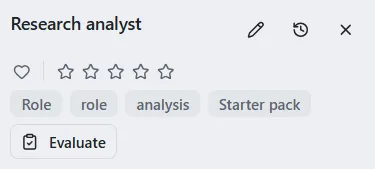
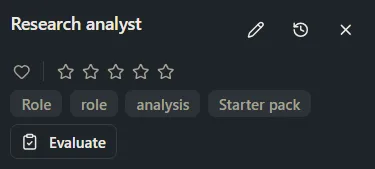
While you edit, the editor shows AI assist instead (see Improve text with AI assist).
Grade an item
-
Select the block, prompt or document on the Blocks or Prompts screen.
-
Click Evaluate.
-
Under Evaluation, Grade is already chosen.
-
Under Model, check the provider and model. Choose another if you want.
-
Click Run, or press Enter.
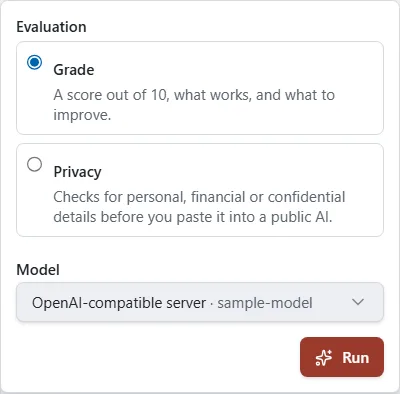
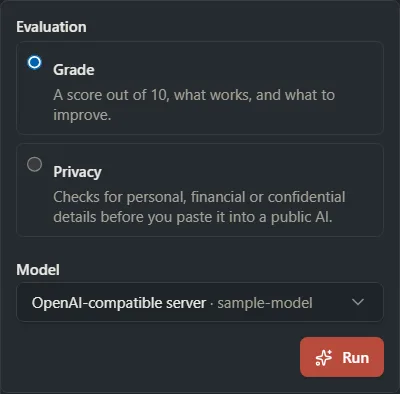
A panel opens at the top of the item. It shows “[Provider] is grading…” while the notes arrive, then “Grade from [Provider]”.
Reading a grade
The model is asked to answer in this order:
-
The first line is the score, for example Score: 7/10.
-
The next line starts What works: and says what’s good about it.
-
Then come two to four suggestions, one per line, saying what to change.
-
For a prompt made of blocks, each suggestion starts with the type of the block it’s about, for example “Constraints: no output length is stated”. Change that block to act on it.
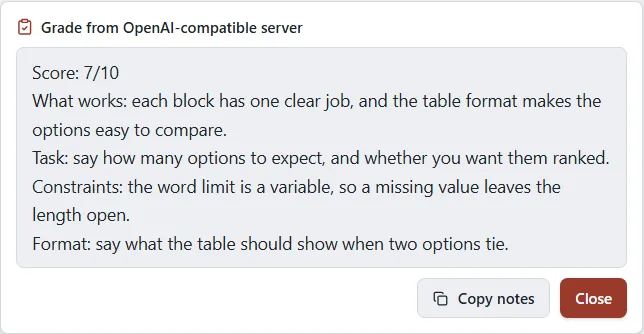
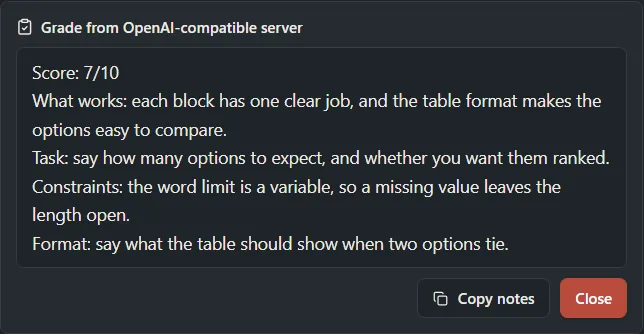
To act on a suggestion, edit the item yourself, or open it for editing and paste the suggestion into What should change? (optional) in AI assist.
Check for private details
- Select the block, prompt or document.
- Click Evaluate.
- Under Evaluation, click Privacy.
- Check Model. If the local model is downloaded, it’s chosen for you, so the text stays on this computer. If you choose a cloud provider, a line under it says Sends the text to followed by the provider’s name.
- Click Run.
The panel shows “[Provider] is checking…”, then “Privacy check from [Provider]”.
Reading a privacy check
The model is asked to answer in this order:
-
The first line is a score, for example Score: 8/10. 10/10 means nothing sensitive was found; a lower score means more, or more serious, findings.
-
The next line starts What works: and says what’s already safe.
-
Then there’s one line for each finding, up to five: what kind of detail it is, the value with most of it hidden (for example “Sam R***”), and how to fix it.
-
If nothing was found, the last line says Nothing sensitive found.
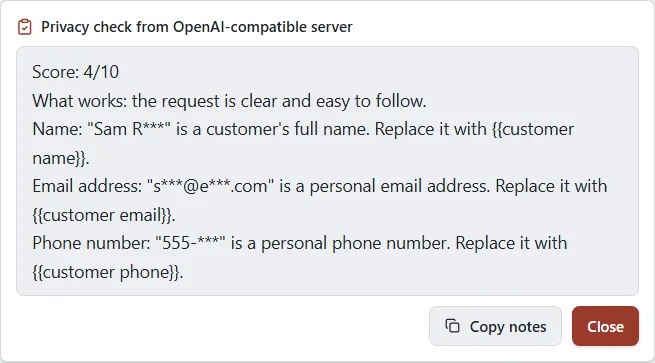
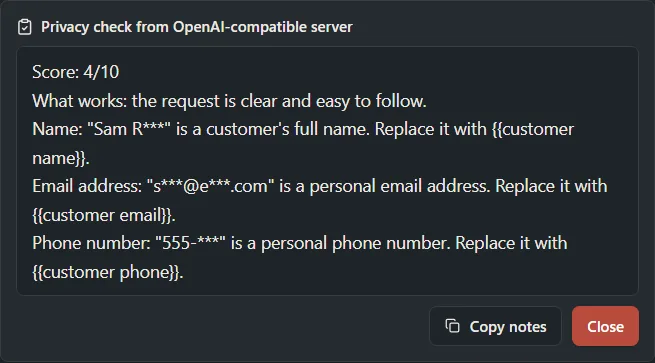
In a block or prompt, the usual fix is to replace the detail with a variable, such as {{client name}}. PromptMason fills in a variable only when you copy or run the prompt, so the value isn’t kept in the text. In a Markdown document, remove the detail or describe it in general words.
An AI model can miss things. Read the text yourself before you share it.
Stop, copy or close the notes
- Stop ends the notes early. The panel then says You stopped this early, so it is only part of a grade. (or a privacy check.)
- Copy notes copies the notes to the clipboard. The button shows Copied.
- Close closes the panel.
What gets evaluated
- The saved item. Save your changes before you evaluate.
- Variables stay as written, such as {{client name}}. Values are never filled in.
- Hidden notes are left out.
- A dynamic prompt is read as a whole, block by block, in order.
- A Markdown document is read exactly as stored.
With a cloud provider, the item’s text and Evaluate’s instructions go to that provider when you click Run: for Grade, also its name and, for a prompt made of blocks, each block’s type and name. The Before you use AI assist window asks first, until you tick its Don’t show this again box (see Before text is sent to a provider). With the local model, none of your text leaves your computer. See What AI features send, and where.
To change what Evaluate asks the model, edit the Grade and Privacy check entries in the AI instructions.
If something goes wrong
| Message | What to do |
|---|---|
| This block has no text to evaluate yet. (or prompt, or document) | Add text, save, then evaluate. |
| This prompt is too long to evaluate: AI assist works on text up to [N] characters. | Shorten the item. For a prompt made of blocks, you can evaluate its library blocks one at a time on the Blocks screen. |
| A message about a provider or the local model | Evaluate shows the same messages as AI assist. See If something goes wrong and Free, private AI on your PC. |
If your library is paused, Evaluate is paused too: the paused message shows and nothing is sent. See When your library is paused.
Want a hand?
Copy this prompt into Claude, ChatGPT or another AI assistant, and it walks you through it step by step.
I want to use Evaluate in PromptMason to check one of my prompts. Explain the difference between “Grade” and “Privacy”, help me run one, and help me act on the notes it gives me.
Copy adds a short note about PromptMason and this guide's steps, so the assistant has what it needs.
I want to use Evaluate in PromptMason to check one of my prompts. Explain the difference between “Grade” and “Privacy”, help me run one, and help me act on the notes it gives me. About PromptMason: a Windows desktop app for building AI prompts from reusable blocks. A person writes blocks (reusable pieces of prompt text), builds prompts from them on the Build screen (or keeps a Markdown document, such as a Skill), and copies a prompt into an AI tool, runs it in PromptMason’s own Chat, or lets a connected AI agent use it through PromptMason’s built-in MCP server (the Chrome extension copies prompts on any website). AI assist, Evaluate and Chat use a local model that runs on the person’s PC, or their own AI provider. The guides are also on PromptMason’s Help screen, and Chat can answer “how do I” questions from them. Libraries hold the blocks and prompts; a person can sync their personal library to their other PCs and share team libraries, both through a folder in cloud storage they already have (OneDrive, Google Drive or Dropbox). Everything synced is encrypted and every edit is signed and checked. A recovery kit (a file plus a code) is the spare copy of the person’s keys, for when every PC is lost. The official guide for this is "Evaluate a block, prompt or document": https://promptmason.ai/docs/evaluate Its full text follows, between the lines. Use it as the source of truth, and if anything I see differs from it, tell me rather than guessing. --- Evaluate reads a saved block, prompt or Markdown document and gives you notes on it. There are two kinds: - **Grade**: a score out of 10, what works, and what to improve. - **Privacy**: a check for personal, financial or confidential details before you paste the text into a public AI. Evaluate never changes the item and doesn't save anything. It's on every plan. ## Before you start Evaluate needs the same two things as AI assist: the **AI assist** switch on in **Settings → Features**, and the local model downloaded or an AI provider set up. Until then, the **Evaluate** button doesn't appear. See [Set up AI](https://promptmason.ai/docs/ai-setup). ## Where to find Evaluate The **Evaluate** button shows when you're viewing an item, not editing it: - **Blocks:** select a block. - **Prompts:** select a static prompt, a dynamic prompt or a Markdown document. While you edit, the editor shows **AI assist** instead (see [Improve text with AI assist](https://promptmason.ai/docs/ai-assist)). ## Grade an item 1. Select the block, prompt or document on the **Blocks** or **Prompts** screen. 2. Click **Evaluate**. 3. Under **Evaluation**, **Grade** is already chosen. 4. Under **Model**, check the provider and model. Choose another if you want. 5. Click **Run**, or press Enter. A panel opens at the top of the item. It shows "[Provider] is grading…" while the notes arrive, then "Grade from [Provider]". ### Reading a grade The model is asked to answer in this order: - The first line is the score, for example **Score: 7/10**. - The next line starts **What works:** and says what's good about it. - Then come two to four suggestions, one per line, saying what to change. - For a prompt made of blocks, each suggestion starts with the type of the block it's about, for example "Constraints: no output length is stated". Change that block to act on it. To act on a suggestion, edit the item yourself, or open it for editing and paste the suggestion into **What should change? (optional)** in AI assist. ## Check for private details 1. Select the block, prompt or document. 2. Click **Evaluate**. 3. Under **Evaluation**, click **Privacy**. 4. Check **Model**. If the local model is downloaded, it's chosen for you, so the text stays on this computer. If you choose a cloud provider, a line under it says **Sends the text to** followed by the provider's name. 5. Click **Run**. The panel shows "[Provider] is checking…", then "Privacy check from [Provider]". ### Reading a privacy check The model is asked to answer in this order: - The first line is a score, for example **Score: 8/10**. **10/10** means nothing sensitive was found; a lower score means more, or more serious, findings. - The next line starts **What works:** and says what's already safe. - Then there's one line for each finding, up to five: what kind of detail it is, the value with most of it hidden (for example "Sam R***"), and how to fix it. - If nothing was found, the last line says **Nothing sensitive found.** In a block or prompt, the usual fix is to replace the detail with a [variable](https://promptmason.ai/docs/variables), such as {{client name}}. PromptMason fills in a variable only when you copy or run the prompt, so the value isn't kept in the text. In a Markdown document, remove the detail or describe it in general words. An AI model can miss things. Read the text yourself before you share it. ## Stop, copy or close the notes - **Stop** ends the notes early. The panel then says **You stopped this early, so it is only part of a grade.** (or **a privacy check.**) - **Copy notes** copies the notes to the clipboard. The button shows **Copied**. - **Close** closes the panel. ## What gets evaluated - The **saved** item. Save your changes before you evaluate. - Variables stay as written, such as {{client name}}. Values are never filled in. - Hidden notes are left out. - A dynamic prompt is read as a whole, block by block, in order. - A Markdown document is read exactly as stored. With a cloud provider, the item's text and Evaluate's instructions go to that provider when you click **Run**: for **Grade**, also its name and, for a prompt made of blocks, each block's type and name. The **Before you use AI assist** window asks first, until you tick its **Don't show this again** box (see [Before text is sent to a provider](https://promptmason.ai/docs/ai-assist#before-text-is-sent-to-a-provider)). With the local model, none of your text leaves your computer. See [What AI features send, and where](https://promptmason.ai/docs/ai-privacy). To change what Evaluate asks the model, edit the **Grade** and **Privacy check** entries in [the AI instructions](https://promptmason.ai/docs/ai-instructions). ## If something goes wrong | Message | What to do | |---|---| | **This block has no text to evaluate yet.** (or prompt, or document) | Add text, save, then evaluate. | | **This prompt is too long to evaluate: AI assist works on text up to** [N] **characters.** | Shorten the item. For a prompt made of blocks, you can evaluate its library blocks one at a time on the **Blocks** screen. | | A message about a provider or the local model | Evaluate shows the same messages as AI assist. See [If something goes wrong](https://promptmason.ai/docs/ai-assist#if-something-goes-wrong) and [Free, private AI on your PC](https://promptmason.ai/docs/local-model#messages-and-what-to-do). | If your library is paused, Evaluate is paused too: the paused message shows and nothing is sent. See [When your library is paused](https://promptmason.ai/docs/paused-library). --- How to help me: - Go one step at a time. After each step, ask what I see on screen before giving the next one. - Use the exact words on PromptMason’s buttons and screens, as the guide does. - Never ask me for my recovery code, my recovery kit file, a password or my invite line, and never ask me to paste them here. - Start by asking which step I’m on, or what I see now.